


Agriculture Loan 2026
Agricultural loans are of huge help to farmers in funding their agricultural operations and to stock up on fertilizers, seeds, insecticides and labour. These loans are taken by farmers for traditional crop cultivation and allied activities such as poultry, pisciculture, land acquisition, and machinery upgrades. With low interest rates such as 7.00% p.a., agriculture loans provide timely and affordable capital. Read our comprehensive guide to understand the various types of loans, popular government schemes, the application process and eligibility criteria for availing an agricultural loan in India.

Agriculture Loan Interest Rates Across Various Banks in India
The listed below are the interest rates for agricultural loans for various banks in India:
Bank | Interest Rate | Processing Fee |
State Bank of India | At the discretion of the bank | At the discretion of the bank |
IDBI Bank | At the discretion of the bank | At the discretion of the bank |
IndusInd Bank | 7.00% - 13.25% p.a. | 2% of the loan amount + GST |
Central Bank of India | 7.00% p.a. onwards | Up to 0.30% of the loan amount |
Karur Vysya Bank | At the discretion of the bank | At the discretion of the bank |
Types of Agriculture Loans
Given below is the list of types of agriculture loans that you can avail for yourself:
- Crop Loans - Crop loans, also referred to as Retail Agri Loans, help farmers manage seasonal costs like equipment maintenance , sowing and post harvest operations. Farmers receive a Kisan Credit Card (KCC) with this loan, enabling them to withdraw funds for essential farming purchases.
- Agricultural Term Loan - These are long-term loan schemes which a farmer can avail to meet their non-seasonal expenses. One can avail this loan to buy or upgrade equipment such as windmills, solar power, etc. The repayment tenure for such loan schemes can be extended up to 4 years, allowing the amount to be repaid by the farmer in a convenient manner.
- Solar Pump Set Loan - A solar pump set loan is the appropriate option to be availed if a farmer is involved in small irrigation projects and requires capital for the purchase of a photo voltaic pumping system. The repayment tenure for such loan schemes goes up to 10 years.
- Loan for Allied Agricultural Activities - Such type of loans can be applied for by farmers involved in allied agricultural activities if working capitals need to be raised to meet their farming expenses.
- Farm Mechanisation Loan - These types of loan schemes can be applied for if working capital is required by a farmer so that new farming machineries can either be purchased or existing ones upgraded, such as a new tractor being purchased or an old one being repaired.
Popular Agriculture Loan Schemes in India
A diverse array of popular agricultural loan schemes is offered by various financial institutions in India to cater to the specific credit requirements of the farming sector. These schemes are designed to ensure that timely and affordable financial assistance is provided to farmers for both short-term and long-term agricultural needs.
- Agricultural Gold Loan: The applicant can avail this type of loan by pledging their gold ornament as security. Various farming expenses, such as the buying of machinery or the meeting of costs related to the cultivation of crops, can be met by the use of the loan amount.
- Forestry Loan: Forestry loans are available to individuals growing crops on trees. Activities such as converting barren land, establishing irrigation, and clearing wild trees can be funded by these loans.
- Horticultural Loan: A horticultural loan can be applied for by farmers involved in setting up vegetable farms and orchards, which not only allows the cost of managing such type of farms to be met, but also helps in meeting the expenses related to other horticulture activities such as wild trees being cleared, a fence being set up, etc.
Top Banks Offering Agriculture Loans in India
Leading financial institutions in India offer specialized credit facilities to support the diverse needs of the farming community. These organizations provide essential funding for a wide range of agricultural and allied activities, ensuring that farmers have access to the capital required for growth and sustainability.
Name of the bank | Agriculture loan schemes offered |
State Bank of India |
|
Karur Vysya Bank |
|
IndusInd Bank |
|
How to Apply for an Agriculture Loan?
- Step 1: Compare lenders and loan options online
- Step 2: Apply via branch or official website
- Step 3: Fill the form, submit required documents
- Step 4: Await verification and approval
- Step 5: Loan amount is credited to your account upon approval
Why Should You Take an Agriculture Loan?
Purchase of farming machinery and equipment:
Essential tools like tractors, harvesters, and power tillers are bought by farmers using these funds. Tasks are automated and overall productivity on the field is increased through this investment.
Purchase of land:
Farmers acquire additional acreage through agricultural loans to expand their existing cultivation area. Farmers can scale-up operations and increase long-term crop yield via this assistance.
Horticulture projects:
Farmers can utilize this capital to set up orchards, greenhouses, and vegetable farms. The intensive management required for high-value fruits, flowers, and plantation crops is supported by the funding.
Purchase of vehicles:
Farmers can buy transport vehicles like trucks and pick-up vans to move their produce from the farm to the market.
Establishment of dairy units:
Funds are used to support various aspects of the dairy business, like acquiring cattle for efficient milk production, constructing sheds for providing shelter for the livestock and providing the intensive care required for high-yield breeds.
Establishment of small poultry units :
The loan funds help in establishing poultry houses for intensive rearing, rapid growth of chicks, quick capital turnover by meat production and daily revenue by egg production.
For working capital needs:
Agricultural loans are helpful for ensuring continuous operations and covering essential inputs like seeds, fertilizers and pesticides.The loan basically provides necessary liquidity for maintaining the farming cycle.
For seasonal requirements:
Seasonal spikes come in with its associated costs and farmers can utilize agricultural loans to cover those costs. Additionally it helps cover costs of sowing, harvesting and any extra labour.
For fish farming:
Farmers of aquaculture can avail agricultural loan for maintenance of ponds, for fingerlings. It can also be utilized for quality fish feed that accelerates growth rates.
Features and Benefits of Agriculture Loans
The key features and benefits of agriculture loans are as follows:
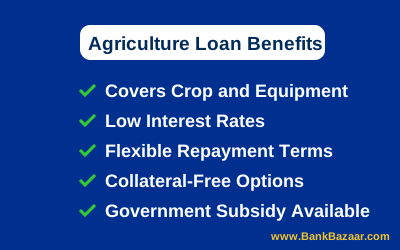
- Simplified Documentation: When borrowing an agriculture loan, applicants will only have to submit a few documents such as a valid photo identity proof, proof of residence, etc. These documents can be submitted along with one's application form.
- Quick Processing: Lenders will verify your application form and the documents submitted by you, after which your loan application will be approved. The loan amount will be disbursed to your account soon after this.
- Competitive Interest Rate Charged: Banks and financial institutions that offer agriculture loans charge a competitive rate of interest that start as low as 8.80% p.a. Borrowing a loan with such a low interest rate can help you keep the overall cost of your loan down.
- Loan Repayment Tenure Options: Many agriculture loan providers offer short- and long-term credit solutions. Thus, based on your financial requirements and repayment capacity, you can opt for a loan product that offers a suitable product term.
- No Hidden Charges: When you borrow an agriculture loan, you may need to pay other charges such as the processing fee, pre-payment charges, etc. However, lenders will usually inform prospective borrowers about the various charges that they may have to pay for before the loan is borrowed.
Documents Required for Agriculture Loans
The documents that you may be asked to submit at the time of applying for an agriculture loan are as follows:
- Duly filled application form
- KYC documents
- Land/asset documents
- Security PDC
- Any other document mandated by the lender
Eligibility Criteria to Borrow an Agriculture Loan
The eligibility criteria to borrow an agriculture loan will vary based on the type of loan scheme that you opt for. The generalised eligibility criteria, however, are as follows:
- The applicant must be between 18 and 70 years.
- The individuals will have to own the necessary assets, which will need to be hypothecated to the bank once the loan is borrowed.
- Loans can be applied on an individual basis or joint basis, based on the lender's terms and conditions.
Highlights from the Interim Union Budget 2024–25 for Agriculture Sector
The highlights of the Interim Union Budget 2024 in terms of agriculture are given below:
- Agriculture given a budget of about Rs.1,27,470 crore in India's interim budget for 2024–2025
In acknowledgment of the vital importance of agriculture, the interim union budget has earmarked Rs.1,27,469.88 crore for the Ministry of Agriculture. Within this allocation, the Department of Agriculture receives Rs.1,17,528.79 crore, while the Department of Agricultural Research and Education (DARE) is allotted Rs.9,941.09 crore.
- Target for agriculture credit of Rs.20 lakh crore
The agriculture credit target has been increased to Rs.20 lakh crore in the Interim Budget 2024-2025, with a focus on welfare initiatives for farmers. Funding for the Agriculture Accelerator Fund, introduced in Budget 2023-24, continues to support rural entrepreneurs and agricultural startups, promoting innovative solutions to farming challenges and modernizing agricultural practices for improved productivity and profitability.
Allocation for the PM Kisan Samman Nidhi remains unchanged at Rs.60,000 crore, providing direct financial assistance to 11.8 crore marginal and small farmers.
- Money set aside for PMFBY's continued rollout
Acknowledging the challenges encountered by farmers, the continued implementation of the Pradhan Mantri Fasal Bima Yojana (PMFBY) has been allocated funds. This crop insurance initiative aims to offer security to four crore farmers, safeguarding them from unexpected events such as adverse weather conditions. The Government is dedicated to improving the efficacy of crop insurance by enhancing awareness and accessibility in rural regions, thereby stimulating growth in the insurance sector.
- Addressing post-harvest losses through public-private partnerships to enhance infrastructure and storage facilities
India grapples with substantial post-harvest losses, amounting to 5–13% for fruits and vegetables and 3–7% for other crops annually, resulting in an estimated loss of Rs.1,52,000 crore. To tackle this pressing issue, the budget underscores the importance of public-private partnerships to upgrade infrastructure and storage facilities. By mitigating losses, India can bolster food security and stimulate overall economic growth.
- 1361 mandis are integrated into e-NAM
India's agricultural sector is undergoing a digital revolution, exemplified by the integration of additional mandis with the e-NAM platform. The electronic National Agricultural Market (e-NAM) serves as a pan-India trading portal, consolidating various State-run Agricultural Produce Marketing Committees (APMCs) mandis. The interim budget aims to integrate 1,361 mandis, projecting an increase in trading volumes to Rs.3 lakh crore in 2024-2025, benefiting 1.8 crore farmers. This initiative represents a significant stride towards establishing a more efficient and transparent agricultural market system.



FAQs on Agriculture Loan
- What are the different stages involved in the process of availing an agriculture loan?
The key stages involved in the process of availing an agriculture loan are as follows: Submission of application form and relevant documents Lender processes the application Loan amount is sanctioned Loan amount gets disbursed into the customer's savings account
- How long do lenders take to process agriculture loan applications?
The time required to process your application will vary based on the lender's terms and conditions. That said, most lenders take around 7 days to process loan applications.
- What are the other allied activities eligible for agricultural loans?
In addition, purchasing of land, or purchasing of agricultural tools, storage of produce and transport also are included under purview of agricultural loans.
- Can a loan be availed for purchase of land?
Yes, banks do extend loans to farmers for purchasing lands. However, banks usually finance purchase of land within a radius of 3 to 5 Kms of their residence or within village boundary.
- Can I pre-close my agriculture loan before the completion of the loan tenure?
Most lenders will allow you to prepay the outstanding loan balance and pre-close the loan amount before the completion of the loan tenure. However, you may need to pay a pre-closure penalty to the lender.
- Do I need a guarantor to avail an agriculture loan?
Yes, most lenders will require you to have a guarantor.
- Can loans be availed for purchasing land in the name of women?
Yes, it is possible. As per Govt policy women owning land could lead to their empowerment. Hence, purchase of land in women can be financed and preference can be given to women in distress, SHG members and widows etc.
Personal Loans by Bank
- SBI Personal Loan
- HDFC Personal Loan
- IDFC First Personal Loan
- Kotak Personal Loan
- Axis Personal Loan
- Yes Bank Personal Loan
- IDBI Personal Loan
- Indusind Personal Loan
- Standard Chartered Personal Loan
- RBL Personal Loan
- Indian Bank Personal Loan
- Canara Bank Personal Loan
- Bank of Baroda Personal Loan
- Bank of India Personal Loan
- Central Bank of India Personal Loan
- Punjab National Bank Personal Loan
- Union Bank Personal Loan
- IOB Personal Loan
- Bank of Maharashtra Personal loan
- UCO Bank Personal Loan
- Punjab and Sind Bank Personal Loan
Personal Loan Eligibility by Banks
- SBI Personal Loan Eligibility
- HDFC Personal Loan Eligibility
- Kotak Personal Loan Eligibility
- Axis Bank Personal Loan Eligibility
- SCB Personal Loan Eligibility
- Tata Capital Personal Loan Eligibility
- IDBI Bank Personal Loan Eligibility
- Indusind Personal Loan Eligibility
- RBL Personal Loan Eligibility
- Yes Bank Personal Loan Eligibility
- Canara Bank Personal Loan Eligibility
- Bank of Baroda Personal Loan Eligibility
- PNB Personal Loan Eligibility
- IOB Personal Loan Eligibility
- Union Bank Personal Loan Eligibility
- Central Bank of India Personal Loan Eligibility
- UCO Bank Personal Loan Eligibility
- Bank of India Personal Loan Eligibility
- Bank of Maharashtra Personal Loan Eligibility
Personal Loan Interest Rates by Bank
- HDFC Personal Loan Interest Rates
- Kotak Personal Loan Interest Rates
- SBI Personal Loan Interest Rates
- Axis Bank Personal Loan Interest Rates
- SCB Personal Loan Interest rates
- Tata Capital Personal Loan Interest rates
- RBL Bank Personal Loan Interest rates
- YES Bank Personal Loan Interest rates
- Canara Bank Personal Loan Interest Rates
- Bank of Baroda Personal Loan Interest Rates
- Punjab National Bank Personal Loan Interest rates
Personal Loan EMI Calculator by Bank
- HDFC Personal Loan EMI Calculator
- AXIS Bank Personal Loan EMI Calculator
- Kotak Personal Loan EMI Calculator
- SCB Personal Loan EMI Calculator
- SBI Personal Loan EMI Calculator
- TATA Capital Personal Loan EMI Calculator
- YES Bank Personal Loan EMI Calculator
- PNB Personal Loan EMI Calculator
- Canara Bank Personal Loan EMI Calculator
Personal Loan Customer Care by Bank
- SBI Personal Loan Customer Care
- HDFC Personal Loan Customer Care
- IDFC First Personal Loan Customer Care
- Kotak Personal Loan Customer Care
- Axis Bank Personal Loan Customer Care
- TATA Capital Personal Loan Customer Care
- Shriram Finance Personal Loan Customer Care
- Indusind Personal Loan Customer Care
- Indiabulls Personal Loan Customer Care
- BOB Personal Loan Customer Care
- IIFL Bank Personal Loan Customer Care
- Yes Bank Personal Loan Customer Care
- RBL Personal Loan Customer Care
- Punjab National Personal Loan Customer Care
- Canara Personal Loan Customer Care
Personal Loan Status Track by Bank
- HDFC Bank Personal Loan Status
- IDFC First Personal Loan Status
- Yes Bank Personal Loan Status
- Tata Capital Personal Loan Status
- Axis Bank Personal Loan Status
- KOTAK Bank Personal Loan Status
- IndusInd Personal Loan Status
- SBI Bank Personal Loan Status
- PNB Bank Personal Loan Status
- Canara Bank Personal Loan Status
- Mahindra Finance Personal Loan Status
Personal Loan Articles
- Top Personal loan Finance Companies
- Personal Loan without Documents
- Personal Loan Verification Process
- Personal Loan Disbursal Process
- Personal Loan Preclosure Procedure
- Personal Loan for NRI
- Personal Loan Prepayment
- Pre Approved Personal Loan
- Personal Loan for Non Listed Companies
- Personal Loans by Private Sector Banks
- Microfinance Institutions
- Financial Inclusion Schemes in India
- Process of Bank Guarantee
- Promissory Notes
- Credit Appraisal
- Project Financing
- Statutory Liquidity Ratio
- Marginal Standing Facility
- Personal Loan Preclosure Calculator
- HDFC Bank Personal Loan Preclosure
Other Loans
- Mudra Loan
- Mortgage Loan
- MSME Loan
- Buy Now Pay Later
- Instant Loan
- NABARD
- SIDBI
- SKS Microfinance
- Agriculture Loan
- Business Start up Loan
- Marksheet Loan
- Loans For Unemployed
- Personal Loan for Low Salary
- Personal Loans by NBFCs
- Personal Loan for Govt Employees
- Personal Loan on Aadhar Card
- Personal Loan Insurance Plans
- Personal Loan Top Up
- Personal Loan for Salaried Employees
- Personal Loan for Self Employed

Disclaimer
Credit Card:
Credit Score:
Personal Loan:
Home Loan:
Fixed Deposit:


Copyright © 2026 BankBazaar.com.