


MSME Loan Scheme 2026
MSME loan schemes offer affordable credit for growth, working capital, and upgrades, with rates starting from 8.50% p.a. (approximately). It helps in supporting entrepreneurship and employment through banks, NBFCs (Non-Banking Financial Institutions), and government programs.

What is an MSME Loan?
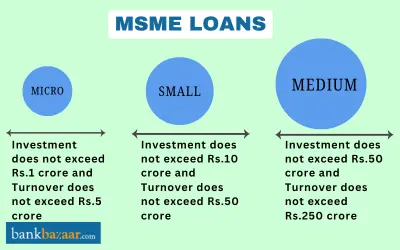
An MSME loan is a type of financing provided to Micro, Small, and Medium Enterprises (MSMEs) to support their business operations. These loans help entrepreneurs and business owners meet various needs, such as purchasing equipment, managing working capital, paying employee salaries, expanding operations, or covering other business expenses. Many financial institutions and banks in India offer MSME loans with varying interest rates and terms.
How to Apply for MSME Loan Schemes?
You can apply for MSME loan schemes through both online and offline mode. Here are the steps to apply for the loan schemes:
- Step 1: Complete Udyam Registration
If your business is not already registered, complete Udyam Registration through the official Government of India portal. Most MSME-linked schemes require this registration.
- Step 2: Identify the Suitable MSME Scheme
Visit the Ministry of MSME portal, the Jan Samarth portal, or the official website of a participating bank. Check eligibility criteria, loan limits and required documents.
- Step 3: Select the Mode of Application
Choose whether to apply:
Online through an official government portal or bank website, or
Offline by visiting a participating bank branch.
- Step 4: Submit the Application
Fill in the application form with accurate business and financial details. Upload or submit all required supporting documents.
- Step 5: Undergo Verification
The bank or lending institution will review your application, verify documents and assess eligibility and creditworthiness. You may be contacted for additional information if required.
- Step 6: Receive Approval and Sign the Agreement
If the loan is approved, the lender will issue a sanction letter outlining the terms and conditions. You will need to sign the loan agreement.
- Step 7: Loan Disbursement
After completing all formalities, the approved loan amount will be disbursed to your registered bank account as per the lender’s procedures.
What are the Purposes of MSME Loans?
The Government of India has introduced an array of loan schemes and credit assistance programs helpful to MSMEs, with more focus:
- On MSME Financial Inclusion
- Remove barrier restrictions to formal funding
- Lessen dependence on informal lending
- Establish a stable MSME sector
- Develop a robust MSME structure with competitive financial assistance
- Affordable credit as the goal to further deliver growth, innovation and new employment sustainability opportunities.
- Improves financial health by paying off existing debts.
Key Highlights of MSME Loans
The key highlights of MSME loan schemes are mentioned below:
Sectors covered | Manufacturing, Service, and Trading |
Loan amount | Depending upon the scheme, the amount ranges from Rs.50,000 to Rs.5 crore. |
Collateral | Free under CGTMSE |
Tenure | Depending on the loan type, the tenure ranges from 1 year to 15 years. |
Processing time | Fast loan processing, as quick as 59 minutes under “MSME Loan in 59 Minutes” scheme. |
Eligibility for MSME Loans
The key eligibility criteria for MSME loan schemes are given below:
- Minimum annual business income should be Rs.2 lakh.
- The minimum annual turnover should be Rs.10 lakh.
- Must have strong financial stability and good repayment track record.
- No history of loan defaults.
- A minimum credit score of 750 or above.
- Applicants or authorised signatory must be 21 to 65 years old.
- The applicant or authorised signatory must have at least three years of work experience in the same enterprise or organisation.
- A minimum of 5 years of overall business experience.
All MSMEs operate in the trading, manufacturing, and service sectors and eligible business types are:
- Private Limited Companies
- Public Limited Companies
- Sole Proprietorships
- Partnership Firms
- Limited Liability Partnerships (LLPs)
Documents Required for MSME Loan
To apply for an MSME loan, applicants must submit valid documents proving business identity, financial health, and repayment capability. The list of documents required are given below:
Category | Documents Required |
Identity Proof (KYC Compliance) | Aadhaar Card, PAN Card, Voter ID, Passport, Driving Licence |
Address Proof (Residential and Business) | Utility bills, Rent or Lease Agreement, Property ownership documents, Passport (with updated address) |
Business Registration & Constitution Proof | Udyam Registration Certificate, GST Registration Certificate (if applicable), Partnership Deed, Certificate of Incorporation, MOA, AOA, Shop & Establishment Licence |
Financial Statements & Income Proof | Bank statements (generally last 6–12 months), Income Tax Returns (ITR), Balance Sheet, Profit and Loss Statement, Cash Flow Statement |
Loan Purpose & Project Documents | Project report, Business expansion plan, Machinery or equipment quotations, Working capital requirement details |
Photographs | Passport-size photographs of applicant, partners or directors |
Collateral / Security Documents (If Applicable) | Property title deeds, Valuation reports, Guarantee documents |
Additional / Supporting Documents (If Requested) | KYC of partners/directors, Board Resolution (for companies), Industry-specific licences or approvals |
Note: Depending on the loan type and applicant’s profile, banks and NBFCs may request extra documents. Accurate documentation helps ensure quick approval and hassle-free disbursal.
Benefits of MSME Loans
The key benefits of MSME loans are listed below:
- Starting a New Business: Entrepreneurs may use MSME loans to establish new micro, small or medium enterprises, subject to eligibility criteria and lender assessment.
- Business Expansion: Existing enterprises can utilise loan funds to expand production capacity, enter new markets or scale operations.
- Purchase of Machinery and Equipment: Loans may be used to acquire plant and machinery, tools, testing equipment, furniture, electrical fittings or other business-related assets required for operations.
- Infrastructure Development:Funds may be used for construction, renovation or improvement of business premises. Financing of land purchase is subject to scheme guidelines and lender policies and may not be permitted under certain government-linked schemes.
- Working Capital Requirements: MSME loans may provide working capital support to manage day-to-day operational expenses, including:
- Purchase of raw materials or inventory
- Payment of salaries and wages
- Utility bills and other recurring expenses
- Product or Service Launch: Businesses may use loan funds to introduce new products or services, provided the proposal is commercially viable and approved by the lender.
- Operational Continuity: Access to timely finance helps prevent disruptions in production cycles, supply chains and service delivery.
Types of MSME Loans
The various types of MSME loans available are mentioned below:
Category | Scheme Name | Nature of Support / Detailed Description |
Credit-Linked / Loan-Based Schemes | Prime Minister’s Employment Generation Programme (PMEGP) | A credit-linked subsidy scheme that supports the establishment of new micro-enterprises. Beneficiaries obtain bank loans, and a portion of the project cost is provided as government subsidy, subject to eligibility conditions. |
| 2nd Loan for Upgradation of Existing PMEGP / MUDRA Units | Provides additional financial assistance to eligible existing units for expansion, technology upgradation or modernisation after successful repayment of the first loan. |
| Credit Guarantee Fund Trust for Micro and Small Enterprises (CGTMSE) | Offers credit guarantee cover to banks and financial institutions for collateral-free loans extended to micro and small enterprises, thereby improving access to formal credit. |
| PM Vishwakarma | Provides concessional collateral-free credit support to traditional artisans and craftspeople, along with skill training, toolkit incentives and market linkage assistance. |
| Self Reliant India (SRI) Fund | A Fund of Funds structure designed to provide equity and growth capital support to MSMEs through SEBI-registered daughter funds, rather than direct lending. |
| Raising and Accelerating MSME Performance (RAMP) | A World Bank-supported reform programme aimed at strengthening MSME institutions, improving market access and enhancing credit ecosystem efficiency. It does not provide direct loans to individual enterprises. |
Infrastructure & Cluster Development Schemes | Micro and Small Enterprises Cluster Development Programme (MSE-CDP) | Supports development of industrial clusters by funding common facility centres, infrastructure development and technological upgradation to enhance collective competitiveness. |
| Scheme of Fund for Regeneration of Traditional Industries (SFURTI) | Promotes cluster-based development of traditional industries such as handicrafts and village industries through infrastructure and skill support. |
| Khadi Gramodyog Vikas Yojana | Supports development, modernisation and marketing of khadi and village industry products through institutional assistance. |
| Promotion of MSMEs in North Eastern Region (NER) and Sikkim | Provides regional development support including infrastructure assistance and capacity building for enterprises in the North Eastern states and Sikkim. |
Skill Development & Capacity Building | Entrepreneurship Skill Development Programme (ESDP) | Offers structured training programmes to develop entrepreneurial skills, technical competence and managerial capabilities among prospective and existing entrepreneurs. |
| Assistance to Training Institutions (ATI) Scheme | Provides financial assistance to institutions engaged in conducting MSME-related training, skill development and entrepreneurship programmes. |
| Tool Rooms and Technical Institutions | Establishes and supports advanced tool rooms and technical centres offering high-end manufacturing training, testing facilities and technical consultancy services. |
Marketing & Market Access Support | Procurement and Marketing Support (PMS) Scheme | Enhances marketing capabilities of MSMEs through participation in trade fairs, vendor development programmes and awareness initiatives on public procurement policies. |
| International Cooperation (IC) Scheme | Supports MSMEs in participating in international exhibitions, trade delegations and global business events to improve export potential and global exposure. |
| National SC-ST Hub Scheme | Facilitates capacity building and market linkages for entrepreneurs belonging to Scheduled Caste and Scheduled Tribe communities, particularly in public procurement. |
Innovation & Rural Enterprise Promotion | A Scheme for Promotion of Innovation, Rural Industries and Entrepreneurship (ASPIRE) | Promotes innovation, incubation and rural enterprise development through support for livelihood business incubators and technology business incubators. |
Objectives of MSME Loan Schemes
The key objectives of MSME Loan Schemes are:
- Improving Access to Formal Credit: To enable micro and small enterprises to access institutional finance at reasonable interest rates, thereby reducing dependence on informal and high-cost sources of borrowing.
- Promoting Collateral-Free Lending: To encourage banks and financial institutions to extend credit without requiring collateral security, supported by credit guarantee mechanisms such as the Credit Guarantee Fund Trust for Micro and Small Enterprises (CGTMSE).
- Encouraging Entrepreneurship and Self-Employment: To promote the establishment of new enterprises, particularly among youth, women, first-generation entrepreneurs and socially and economically disadvantaged groups, through credit-linked subsidy and support schemes such as the Prime Minister’s Employment Generation Programme (PMEGP).
- Supporting Business Expansion and Technology Upgradation: To facilitate investment in plant, machinery, equipment and modern technologies that enhance productivity, quality and competitiveness of MSMEs.
- Strengthening Regional and Rural Development: To promote industrialisation and enterprise development in rural, semi-urban and economically underdeveloped regions, thereby supporting balanced regional growth.
- Generating Employment Opportunities: To create sustainable employment by supporting the growth of labour-intensive industries and micro-enterprises across various sectors.
- Enhancing MSME Competitiveness: To improve the financial capacity and resilience of MSMEs so they can integrate into national development initiatives and participate effectively in domestic and global markets.

Prime Minister’s Employment Generation Programme (PMEGP)
The Prime Minister’s Employment Generation Programme (PMEGP) is a government-sponsored flagship credit-linked subsidy programme which aims to create entrepreneurs and jobs in India's non-farm sector.
Credit Guarantee Fund Trust for Micro & Small Enterprises (CGTMSE)
CGTMSE is a flagship initiative started by the Ministry of MSME and SIDBI to provide micro and small enterprises with collateral-free credit. The primary goal is to improve the access to finance that enables banks and NBFCs to lend to MSMEs without collateral, allowing first-time and small-scale entrepreneurs to access entry to financing.
Small Industries Development Bank of India (SIDBI) Support
SIDBI is the quintessential financial institution for the promotion, financing, and development of micro, small and medium enterprises (MSMEs) in India. It operates as a direct lender and refinancier to banks and NBFCs with a mission to enhance access to credit, foster modernization, and catalyze sustainable growth among MSMEs.
Other Relevant MSME Loan Schemes
The table below summarizes the objectives, eligibility, loan details and application process for other MSME Loan Schemes:
Scheme Name | Description & Key Features | Application Steps |
Prime Minister’s Employment Generation Programme (PMEGP) | Credit-linked subsidy scheme promoting new micro-enterprises in India’s non-farm sector. Encourages self-employment and job creation, especially among youth, women, and first-generation entrepreneurs. Subsidy support on bank loans; implemented by KVIC under Ministry of MSME. | 1. Apply to participating bank for loan 2. Bank sanctions loan 3. Subsidy processed by KVIC/nodal agency |
Credit Guarantee Fund Trust for Micro & Small Enterprises (CGTMSE) | Credit guarantee initiative enabling banks and NBFCs to provide collateral-free loans to MSMEs. Covers loans without collateral; encourages lending to new and small enterprises; administered by SIDBI. | 1. Apply for MSME loan with participating bank 2. Bank arranges guarantee coverage 3. Loan sanctioned collateral-free |
SIDBI Support | Principal financial institution for MSMEs. Acts as direct lender and refinancier to banks and NBFCs. Supports access to credit, technology modernisation, and sustainable enterprise growth. | 1. Approach SIDBI or partner bank for loan 2. Submit required documents3. Loan appraisal and sanction by SIDBI/bank |
Credit Linked Capital Subsidy – Technology Upgradation Scheme (CLCS-TUS) | Promotes adoption of modern and energy-efficient machinery among MSMEs. Up to 15% capital subsidy on institutional finance for approved machinery. | 1. Apply for term loan from participating bank 2.Submitloansanction& machinery details3. Bank forwards claim to SIDBI/nodal agency 4. Subsidy credited after verification |
MSME Champions Scheme | Support and competitiveness programme (not a direct loan scheme). Focuses on enhancing productivity, innovation, market linkages, mentoring, and grievance redressal. | 1. Register on Udyami Mitra portal2.Submitproject proposals 3. Receive support as per evaluation |
Interest Subsidy Eligibility Certificate (ISEC) Scheme | Provides concessional working capital loans to KVIC-approved Khadi and village industry institutions. Loans at 4% per annum interest, with subsidy borne by Central Government. | 1. Apply to KVIC for ISEC certificate 2.Submitcertificate to financing bank 3. Loan sanctioned & interest subsidy applied |
PSB Loans in 59 Minutes | Digital platform for rapid loan approval by public sector banks. Loans up to Rs.5 crore (term loan, working capital, Mudra loans); automated appraisal with in-principle approval. | 1. Apply via PSB 59 Minutes portal 2. Upload required documents and project details 3. Bank conducts automated appraisal 4. Loan sanctioned & disbursed digitally |
Pradhan Mantri Mudra Yojana (PMMY) | Provides micro-finance for non-corporate, non-farm enterprises such as traders, service providers, and small businesses. Loans up to Rs.20 lakh (Shishu, Kishore, Tarun categories). | 1. Apply at bank, NBFC, orJanSamarthportal 2.Submitidentity, business proof, and Udyam registration 3. Bank appraises and assigns loan category 4. Loan sanctioned and disbursed |



FAQs on MSME Loans
- What happens if I pay late or fail to pay an MSME loan?
Late payments attract interest and penalties according to your loan agreement. Timely repayment helps maintain your credit score and avoids additional charges or higher interest rates.
- What role does the government play beyond providing MSME loans?
The Ministry of MSME supports enterprises through skill development, cluster development, ICT adoption, quality enablement, and market access programmes. Schemes such as PMKVY 4.0 and PM-NAPS enhance business competitiveness, financial literacy, and sustainable growth opportunities.
- Do all bank branches provide MSME loans?
No. Not all branches are equipped to handle MSME lending. Public sector banks must have at least one specialised MSME branch per district or classify branches with high MSME lending as specialised, particularly in industrial clusters.
- Do banks provide advisory services along with loans?
Yes. Banks and NBFCs often offer guidance on business planning, financial management, and scheme navigation to help entrepreneurs make informed decisions and use loans effectively.
- Are MSME loan schemes available for women and minority entrepreneurs?
Yes. MSME schemes prioritise women, SC/ST, and OBC entrepreneurs by offering financial support, subsidised interest rates, and credit-linked incentives to promote business growth and inclusion.
- How can MSME borrowers increase their chances of loan approval?
Borrowers can improve approval chances by maintaining a good credit score, submitting accurate financial statements, having a sound business plan, and keeping their Udyam Registration current. Demonstrating business viability and repayment capacity strengthens lender confidence.
- Do all banks in India provide MSME loans?
Most public and private sector banks provide MSME loans, as mandated by the RBI under priority sector lending norms. This ensures that MSMEs across the country have access to finance on a level playing field.
- Is a credit rating required for MSME loans?
No. A credit rating is not mandatory, but having a good rating can help secure better loan terms, lower interest rates, and reduced processing fees, making the borrower more attractive to lenders.
- What types of MSME loans are available?
MSMEs can access working capital loans for day-to-day operations, term loans for machinery, equipment, or expansion, equipment or technology loans to upgrade infrastructure and productivity, trade finance or bills discounting for receivables management, and microfinance or Mudra loans for micro-enterprises and small businesses.
News about MSME Loan
Union Budget 2026: Government Announces Support to MSMEs
In the Union Budget 2026, the Finance Minister Ms. Nirmala Sitharaman announced that a dedicated Rs.10,000 crore growth fund aimed at strengthening Micro, Small, and Medium Enterprises (MSMEs). This fund is allocated with the aim of providing equity support to high‑potential MSMEs, so that they can scale, innovate, and compete globally. The government's current focus is on nurturing “champion” enterprises through performance‑based incentives and funding.
RBI Advises Banks to Link MSME Loans to External Benchmark
The government told Parliament that RBI has advised banks to link MSME loans to an external benchmark in order to improve monetary policy transmission. Under this system, loan interest rates will be reset after every three months. Banks have also been asked to allow existing MSME borrowers to switch to the new benchmark-based rates on mutually agreed terms. The government is also implementing Quality Control Orders (QCOs) with exemptions and relaxations for MSMEs. So that there is no disruption to domestic production. To support MSMEs, an extra 10 per cent concession is available that are either located in the northeastern region or managed by women entrepreneurs. Moreover, MSME units are no longer required to maintain an in-house laboratory. The government has also introduced the Mutual Credit Guarantee Scheme for MSMEs to ease access to loans. Banks are not allowed to demand collateral for loans up to Rs.10 lakh for micro and small enterprises.
Union Budget 2024: FM outlines credit guarantee programs for manufacturing MSMEs
During the Union Budget 2024, Finance Minister Nirmala Sitharaman announced on credit guarantee programs for MSMEs in the manufacturing sector, saying that a new scheme will be introduced to facilitate term loans for MSMEs for the purchase of machinery and equipment without collateral and guarantee. Guarantees of up to Rs.100 crore will be provided by this guarantee fund.
Union Budget 2024: Credit Guarantee Schemes for MSMEs
Finance Minister Nirmala Sitharaman announced that the government has introduced the credit guarantee scheme to facilitate loans for MSMEs. Under this scheme, a self-providing guarantee form will be provided to the applicants and the scheme will work to cool off any credit risks for MSMEs.
Personal Loans by Bank
- SBI Personal Loan
- HDFC Personal Loan
- IDFC First Personal Loan
- Kotak Personal Loan
- Axis Personal Loan
- Yes Bank Personal Loan
- IDBI Personal Loan
- Indusind Personal Loan
- Standard Chartered Personal Loan
- RBL Personal Loan
- Indian Bank Personal Loan
- Canara Bank Personal Loan
- Bank of Baroda Personal Loan
- Bank of India Personal Loan
- Central Bank of India Personal Loan
- Punjab National Bank Personal Loan
- Union Bank Personal Loan
- IOB Personal Loan
- Bank of Maharashtra Personal loan
- UCO Bank Personal Loan
- Punjab and Sind Bank Personal Loan
Personal Loan Eligibility by Banks
- SBI Personal Loan Eligibility
- HDFC Personal Loan Eligibility
- Kotak Personal Loan Eligibility
- Axis Bank Personal Loan Eligibility
- SCB Personal Loan Eligibility
- Tata Capital Personal Loan Eligibility
- IDBI Bank Personal Loan Eligibility
- Indusind Personal Loan Eligibility
- RBL Personal Loan Eligibility
- Yes Bank Personal Loan Eligibility
- Canara Bank Personal Loan Eligibility
- Bank of Baroda Personal Loan Eligibility
- PNB Personal Loan Eligibility
- IOB Personal Loan Eligibility
- Union Bank Personal Loan Eligibility
- Central Bank of India Personal Loan Eligibility
- UCO Bank Personal Loan Eligibility
- Bank of India Personal Loan Eligibility
- Bank of Maharashtra Personal Loan Eligibility
Personal Loan Interest Rates by Bank
- HDFC Personal Loan Interest Rates
- Kotak Personal Loan Interest Rates
- SBI Personal Loan Interest Rates
- Axis Bank Personal Loan Interest Rates
- SCB Personal Loan Interest rates
- Tata Capital Personal Loan Interest rates
- RBL Bank Personal Loan Interest rates
- YES Bank Personal Loan Interest rates
- Canara Bank Personal Loan Interest Rates
- Bank of Baroda Personal Loan Interest Rates
- Punjab National Bank Personal Loan Interest rates
Personal Loan EMI Calculator by Bank
- HDFC Personal Loan EMI Calculator
- AXIS Bank Personal Loan EMI Calculator
- Kotak Personal Loan EMI Calculator
- SCB Personal Loan EMI Calculator
- SBI Personal Loan EMI Calculator
- TATA Capital Personal Loan EMI Calculator
- YES Bank Personal Loan EMI Calculator
- PNB Personal Loan EMI Calculator
- Canara Bank Personal Loan EMI Calculator
Personal Loan Customer Care by Bank
- SBI Personal Loan Customer Care
- HDFC Personal Loan Customer Care
- IDFC First Personal Loan Customer Care
- Kotak Personal Loan Customer Care
- Axis Bank Personal Loan Customer Care
- TATA Capital Personal Loan Customer Care
- Shriram Finance Personal Loan Customer Care
- Indusind Personal Loan Customer Care
- Indiabulls Personal Loan Customer Care
- BOB Personal Loan Customer Care
- IIFL Bank Personal Loan Customer Care
- Yes Bank Personal Loan Customer Care
- RBL Personal Loan Customer Care
- Punjab National Personal Loan Customer Care
- Canara Personal Loan Customer Care
Personal Loan Status Track by Bank
- HDFC Bank Personal Loan Status
- IDFC First Personal Loan Status
- Yes Bank Personal Loan Status
- Tata Capital Personal Loan Status
- Axis Bank Personal Loan Status
- KOTAK Bank Personal Loan Status
- IndusInd Personal Loan Status
- SBI Bank Personal Loan Status
- PNB Bank Personal Loan Status
- Canara Bank Personal Loan Status
- Mahindra Finance Personal Loan Status
Personal Loan Articles
- Top Personal loan Finance Companies
- Personal Loan without Documents
- Personal Loan Verification Process
- Personal Loan Disbursal Process
- Personal Loan Preclosure Procedure
- Personal Loan for NRI
- Personal Loan Prepayment
- Pre Approved Personal Loan
- Personal Loan for Non Listed Companies
- Personal Loans by Private Sector Banks
- Microfinance Institutions
- Financial Inclusion Schemes in India
- Process of Bank Guarantee
- Promissory Notes
- Credit Appraisal
- Project Financing
- Statutory Liquidity Ratio
- Marginal Standing Facility
- Personal Loan Preclosure Calculator
- HDFC Bank Personal Loan Preclosure
Other Loans
- Mudra Loan
- Mortgage Loan
- MSME Loan
- Buy Now Pay Later
- Instant Loan
- NABARD
- SIDBI
- SKS Microfinance
- Agriculture Loan
- Business Start up Loan
- Marksheet Loan
- Loans For Unemployed
- Personal Loan for Low Salary
- Personal Loans by NBFCs
- Personal Loan for Govt Employees
- Personal Loan on Aadhar Card
- Personal Loan Insurance Plans
- Personal Loan Top Up
- Personal Loan for Salaried Employees
- Personal Loan for Self Employed

Disclaimer
Credit Card:
Credit Score:
Personal Loan:
Home Loan:
Fixed Deposit:


Copyright © 2026 BankBazaar.com.